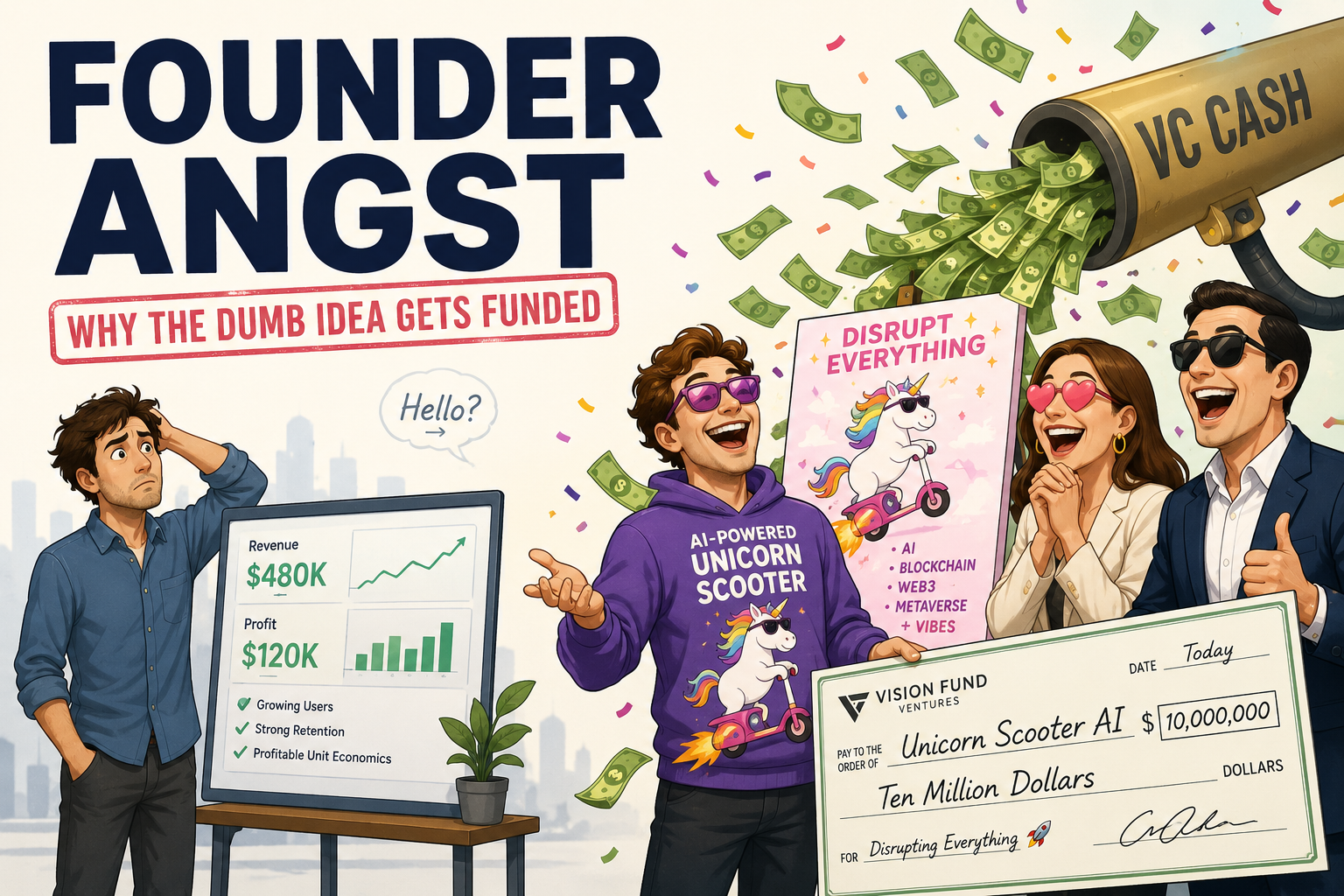
Every founder eventually has the same moment. You watch a company you'd bet is objectively dumber than yours close an oversubscribed round at a valuation that makes your eyes water, while you can't get a second meeting for an idea you know is better, more durable, and has the quaint old-fashioned virtue of actually making money.
Naturally, you begin wondering whether you're the idiot.
What you're feeling is founder angst, a real and predictable condition. Think teenage angst for adults: the bewildered realization that the adults in the room are operating by rules nobody bothered to explain, while the popular kid just got picked for reasons that appear unrelated to the assignment.
I've sat on both sides of this table for almost three decades, and I can tell you the popular kid usually didn't cheat. The game itself is simply not the game you thought you were playing.
Here are the classic reasons a dumb-sounding idea raises millions while your better one goes unfunded at any price.
Most founders assume VCs are shopping for the best business.
They're shopping for a business that can absorb the size of check their fund requires them to write without immediately setting the money on fire.
A fund that raised $500 million from its LPs can't write you a disciplined $750,000 seed check and declare victory. The math doesn't work. If a partner spends years making small, careful investments into modest, capital-efficient companies, that fund will never return the multiple its LPs signed up for.
So the fund goes looking for companies capable of swallowing $20 million to $50 million at a gulp, because that's the kind of check that actually moves the needle.
I've called this the foie gras approach before: stuff as much capital as possible down a company's throat and hope something rare and exquisite eventually comes out the other end.
The relevant question isn't necessarily whether your idea is good. It's whether your company is shaped like a vessel capable of holding that much cash without sinking under the weight of it.
And much of that capital is looking in one zip code. Roughly 65% of U.S. venture dollars get invested in Silicon Valley alone. That's an enormous pile of money chasing a limited supply of deals within convenient driving distance of Sand Hill Road. The predictable result is that anything vaguely fundable inside the blast radius gets bid up, while excellent companies outside it wonder whether their email is broken.
I watched this play out in 2000, at my first board meeting as an investor in a dot-com. The lead VC, freshly handed $50 million from a boom-chasing corporate fund, pounded the table and told the founder to get burn up to $1 million a month or be replaced.
Yes, the instruction was literally to burn money faster.
That fund went to zero a few months later when the dot-com bust arrived. The VC left the industry entirely. The founder went back to being someone else's CTO and never started another company.
Nobody in that room was lying. Everyone was simply optimizing for their own economics. Unfortunately, the founder's economics were nowhere near the top of the list.
The mechanism that explains most of this bewilderment is simple: venture capital is a power law business.
A VC fund's entire return may come from one or two companies out of fifty. If one company produces a monster outcome, the fund can work even if the other forty-nine limp along, get acqui-hired, disappear into the wallpaper, or die heroically in a Medium post.
That means a VC is hunting for the rare business with a plausible, however improbable, path to becoming a $1 billion-plus outcome.
That's a much narrower target than "excellent company."
Your idea can be more durable, more profitable, more defensible, and considerably less insane than the company that just raised $40 million and still fail the only test that matters to a power-law investor:
Can this business, if virtually everything breaks right, become big enough to bail out the other forty-nine?
A beautifully run $30 million ARR company with happy customers and healthy margins sounds terrific to almost every rational human being on Earth. To a large venture fund, it can be a rounding error.
Meanwhile, a pre-revenue company taking a wild swing at a trillion-dollar category may fit the model perfectly.
Welcome to venture capital.
The odds back this up. About 60% of startups that raise a pre-seed round never make it to a priced seed round. Roughly 90% never reach a priced Series A. Of the companies that do get institutional venture money, about 75% will fail to return capital to their investors at all.
Out of roughly 75,000 startups that seek institutional venture capital in a given year, only 2,000 to 4,500 will land their first round.
Venture-scale is rare on purpose. The machinery was built to find statistical freaks, not merely good businesses.
Then a category catches fire and otherwise sensible adults start behaving like prospectors who just heard somebody found gold three hills over.
Once a hot deal prices at a big markup, it doesn't only help that company. It can mark up every other company in that VC's portfolio operating in the same space, at least on paper, whether anything about those businesses actually improved.
Revenue didn't change. Customers didn't change. Product didn't change.
Somebody elsewhere simply paid more.
That creates a perfectly rational incentive for investors to pile into the next shiny round in the category, even when they privately suspect the underlying business is held together with PowerPoint, Nvidia credits, and optimism.
The markup helps their paper returns today. Whether the company turns into a crater three years from now is a problem for three-years-from-now people.
This is why gold rush deals can work out beautifully for the VC who got in early, work out beautifully again for the VC who led the next round at a markup, and only become problematic when the music stops.
Then the invoice gets forwarded to somebody else: the later-stage investor who paid full retail, the employees whose options are underwater, or the public shareholders who discover that "AI-enabled" was doing a heroic amount of work in the S-1.
The people who priced the froth are often long gone before the froth is.
The headline number in a funding announcement is almost never the whole story.
Founders nevertheless compare themselves to it as though TechCrunch had just published an audited cap table.
A "$40 million round at a $400 million valuation" can be a rescue financing dressed up as fresh conviction, with a liquidation preference stack that means founders and employees get paid only after investors have been made whole several times over.
It can be an insider round where existing investors are protecting their pro-rata because allowing the company to die would create an awkward conversation at the next LP meeting.
It can contain secondary sales that let the founder quietly take millions off the table while employees continue hearing speeches about "we're all in this together."
None of that fits neatly into the headline.
The waterfall math behind an "obscene valuation" can therefore mean considerably less than the press release suggests, especially for the people whose LinkedIn posts are celebrating it.
You're comparing your unfunded, unstructured, fully-at-risk idea to somebody else's professionally packaged financing announcement.
That was never a fair fight.
Real diligence takes weeks.
A hot round closes in days.
That creates a minor operational problem for investors, which is that properly understanding the company would take longer than the company is apparently available for sale.
So investors fall back on proxies.
Who is this founder? Where did they work? Who invested before? Who made the introduction? Which accelerator stamped the paperwork? Which university, lab, or company appears on the biography?
A resume from a recognized lab, a known accelerator, or one of a relatively small number of trusted university and company networks can perform an enormous amount of unspoken due diligence.
A warm intro from somebody the partner already trusts can substitute for hours of investigation the partner doesn't have time to do.
That isn't a conspiracy. It's triage.
But it means access to capital correlates heavily with access to dense insider networks, sometimes as much as it correlates with the actual quality of the business.
If you're outside those networks, your objectively better idea may never receive a real evaluation.
Instead, it gets a polite form rejection from an associate who spent eleven minutes on the deck and is already late for the partner meeting where everyone will discuss the company their Stanford classmate just introduced.
None of this means your idea is bad, and it certainly doesn't mean every heavily funded idea is secretly brilliant.
Often, the fund that passed on you was never shopping for what you built.
And the fund that wrote the enormous check into the supposedly dumb idea was shopping for something very specific: a company shaped correctly for its fund size, its portfolio math, its return model, and the story its own LPs want to hear.
That's the useful question for founders:
Was I ever playing the game I thought I was playing?
A lot of excellent businesses are not venture-scale businesses. There is no shame in that. Quite the opposite.
A steady, profitable company that pays its founders well, treats employees decently, serves customers, and throws off cash is a win by almost every sane definition of capitalism.
It just may not be a venture capital investment.
If your idea cannot plausibly become the one outlier that bails out the other forty-nine companies in somebody's fund, stop auditioning for that particular stage.
Build the business you actually have. Finance it with a capital structure that actually fits it.
And the next time some startup with twelve employees, no revenue, and a press release containing the phrase "reimagining the future of" raises $70 million at a $600 million valuation, congratulate them.
Then get back to work.

