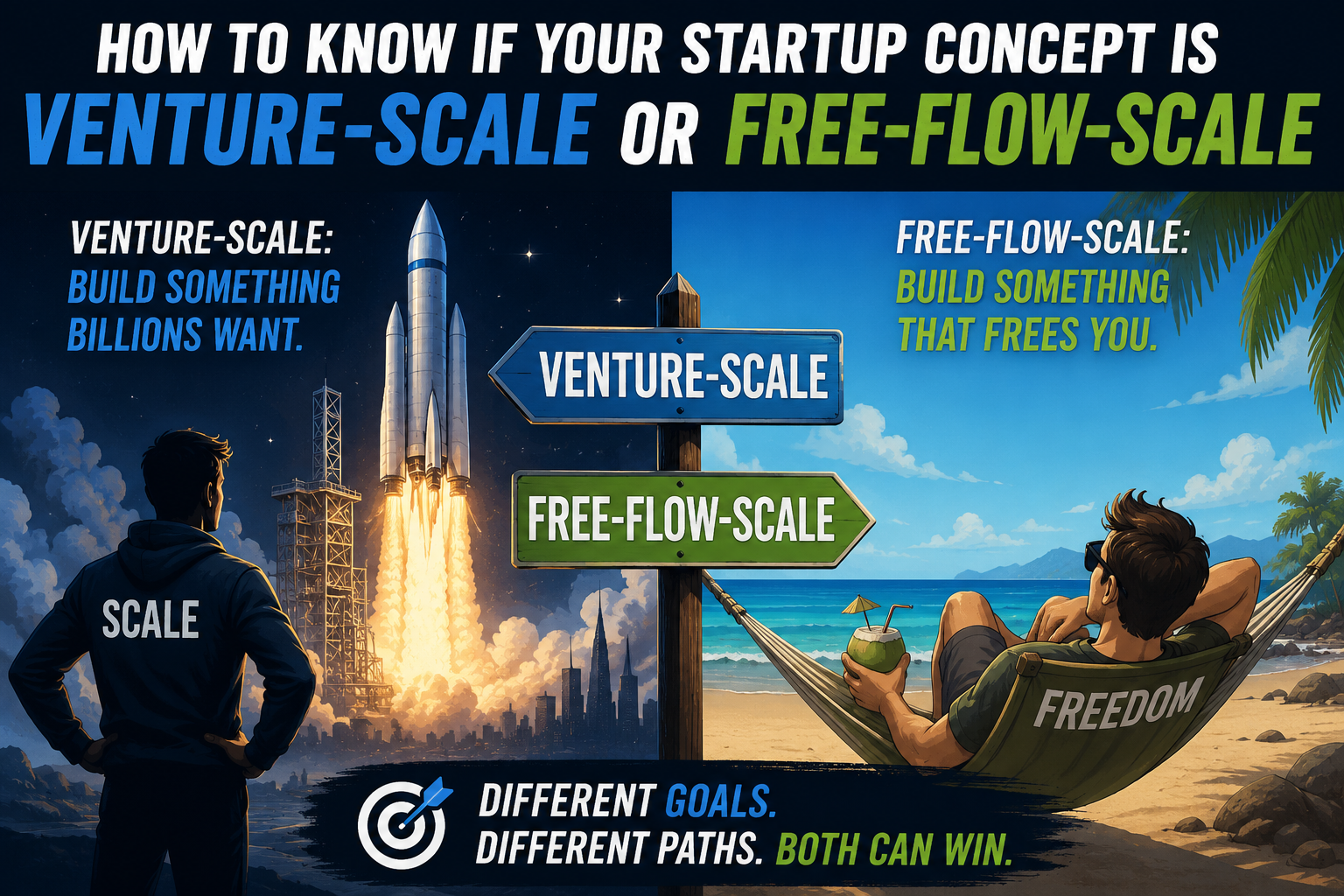
This article replaces our July 2025 piece on the same question. The agentic AI boom broke the old answer, so we rewrote it.
Launching a startup is an exhilarating journey, but before you chase capital of any kind, you need to answer a question that has gotten more interesting in the past year: what scale of outcome does your concept actually support — and which capital structure matches it?
When we first published this article, the question was binary. Either your idea was venture-scale — a potential $100M+ ARR rocket ship worth backing with institutional capital — or it was a "regular" small business. Honorable, sure. But implicitly a consolation prize.
Agentic AI broke that binary.
A two-to-five-person team plus a swarm of AI agents can now build, sell, support, and scale a real software company on a fraction of the capital it took just a couple of years ago. Companies that once needed $3M–$5M to find product-market fit can now reach cash-flow breakeven on $300K–$500K. That's not a lifestyle business. That's a new category — and it deserves its own definition.
So this article now answers two questions instead of one:
Both are legitimate. Both can make founders wealthy. They are simply different machines, built for different economics.
Before we bifurcate anything, a warning: every funding path starts with the same fundamentals. Whether you're pitching a Sand Hill Road VC or a group of angels who love pass-through economics, you still need:
If you can't check those boxes, neither path is open to you yet. (Our Business Plan Checklist walks through all of them, then routes you to the right funding path — the same two paths described below.)
A venture-scale startup is one that can achieve hyper-growth and credibly reach $100M+ in annual revenue within about 10 years, supporting a $1B+ valuation. This definition hasn't changed. What it demands hasn't changed either:
1. A Massive Market (TAM). A total addressable market of at least several billion dollars. Ask yourself: if I dominated this space, could I generate $100M+ in annual revenue? If not, VCs will pass.
2. Hyper-Growth Potential. Investors want to see the potential for 15–30% month-over-month revenue growth. Linear growth, however healthy, isn't venture-scale.
3. Scalability Without Proportional Costs. Technology or platform models where adding customers doesn't mean adding headcount at the same rate.
4. A Reason the Money Matters. This is the criterion founders most often skip. Venture capital only makes sense when a big cash infusion dramatically accelerates your ability to capture a fleeting market opportunity — when speed is existential because a better-funded competitor could run you over from behind. If your business doesn't actually need $5M–$50M to win, taking it anyway just means selling ownership you didn't have to sell.
5. A 10x+ Return Profile. VC fund math depends on rare, enormous wins. If your realistic best case is a $40M exit, you are not what their model is hunting for — no matter how good the business is.
Venture-scale businesses still exist, and agentic AI is creating some of the biggest ones in history. Deep tech, foundation models, biotech, aerospace, capital-intensive infrastructure — the physics haven't changed, and neither has the need for institutional capital in those arenas. If that's you, Path A is your route, and you should run it with eyes wide open. (More on "eyes wide open" below.)
A free-flow-scale startup is a company intentionally designed from day one to reach positive cash flow on less than $1M in total seed investment — typically structured as an LLC rather than a Delaware C-Corp, with profits flowing through to founders and early investors rather than being trapped behind a distant exit.
Here's what qualifies a concept as free-flow-scale:
1. A Credible Path to Breakeven on Under $1M. Typically $50K–$200K from founders and friends-and-family to reach a working product and first customers, then $200K–$700K from angels to reach cash-flow breakeven. If your honest number is under $500K, you are squarely in free-flow territory.
2. Lean AI Economics. One to three founders plus AI agents handling what used to require departments — tier-one support, outbound, content, research, significant amounts of code. Your burn rate looks nothing like a 2021 SaaS startup's.
3. A Vertical Niche You Can Own. Free-flow companies win by wedging into vertical markets underneath incumbents' pricing umbrellas — nailing the features customers actually use with a clean, AI-native architecture, at a fraction of the incumbent's cost structure. You don't need a $10B TAM. You need a defensible niche that supports $2M–$10M+ ARR at 80% gross margins.
4. Distributions as a Real Outcome. This is the "free flow." A company with $3M ARR and $1.5M in annual free cash flow can distribute $1M a year to its members while still funding growth. Over five years, that can beat what most seed-stage exits pay early investors — with no acquisition, no IPO, and no TechCrunch headline required.
5. Optionality Preserved. A free flow LLC is not anti-VC. If the business reveals itself to be genuinely venture-scale, you convert to a Delaware C-Corp — a 30–60 day statutory process — and walk into the institutional market with real revenue and real leverage. That's the strategy working, not failing.
One more thing free-flow-scale is not: it is not the consolation bracket. These are real technology companies with real growth rates and real exits — direct sales, private equity acquisitions (realistic at $2M–$10M ARR), or distributions as the exit itself. They simply don't need dilutive institutional capital to get there.
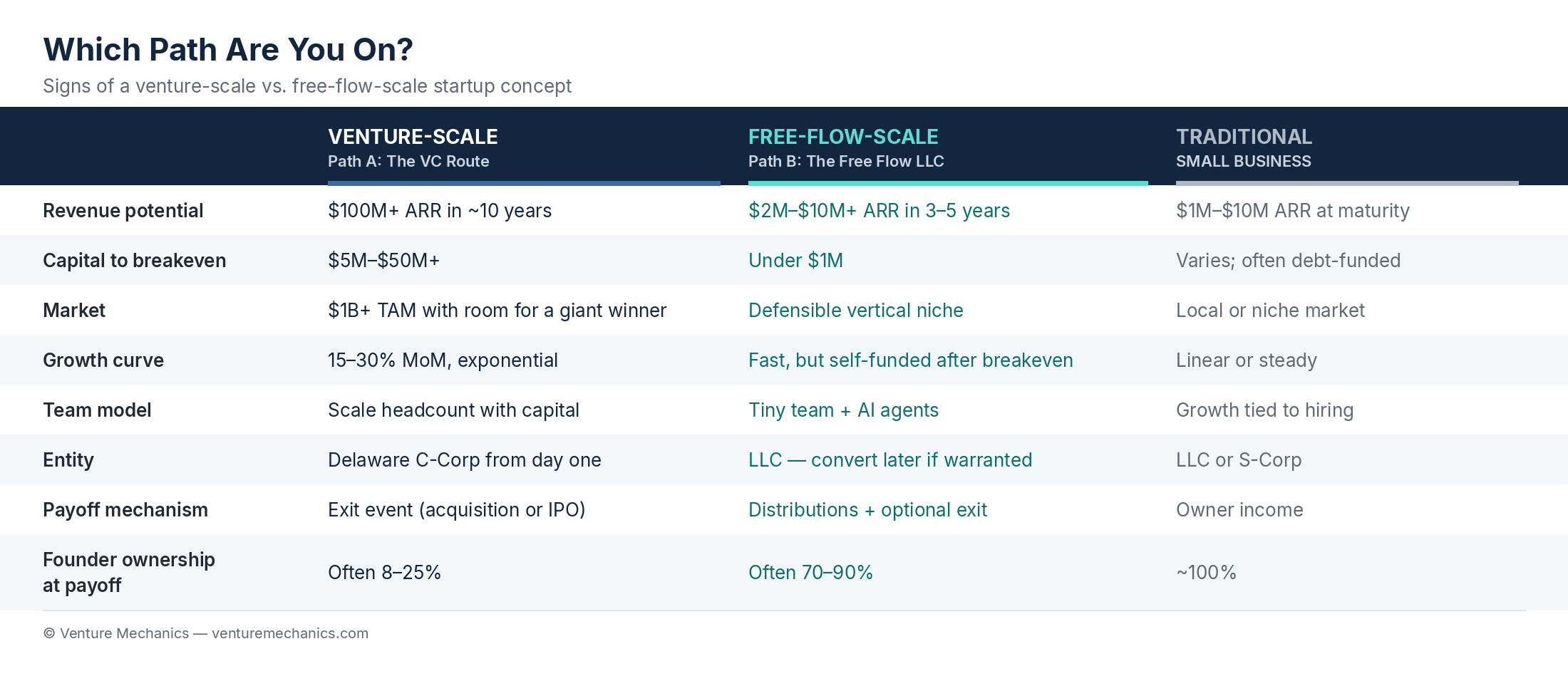
Replace the old pass/fail exam with a routing decision. Answer these honestly:
Founders spend proceeds, not valuations. Here's a comparison drawn from our book Lawyers, Venture Capitalists and Other Useful Predators:
Founder A takes the traditional path: raises $37M across seed, Series A, and Series B, owns 18% at exit, and sells the company for $250M. After preferences and taxes: roughly $27M. A fantastic outcome by any definition.
Founder B runs the free flow playbook: $150K of founder capital plus $500K from angels, owns 80% at exit, and sells for $75M — less than a third of Founder A's headline number. After taxes: roughly $45M.
The smaller exit paid the founder substantially more. That's the ownership multiplier at work: 80% of a modest outcome routinely beats 20% of a headline-grabbing one. Dilution isn't evil — but every point of ownership you surrender should buy something that matters (speed, distribution, market dominance), not validation or a press release.
If you choose the venture route, choose it knowing the cold, hard facts. 60% of startups that raise a pre-seed round fail before reaching seed. 90% fail to reach a priced Series A. Of companies that do receive venture capital, 75% never return capital to their investors.
Out of roughly 5 million new U.S. business starts a year, 900,000 will seek angel funding and only 50,000–70,000 will get a first angel round. 75,000 will seek institutional venture capital; 2,000–4,500 will get a first venture round. And VC-backed startups pay out to founders at roughly a 2.5% rate across the full distribution of outcomes.
Founders take these odds anyway — for impact, autonomy, growth, mission, and yes, the shot at the moon. Venture Mechanics exists to improve those odds, not to dash hopes on the rocks of statistics. But we want everyone stepping onto the field with realistic expectations. And now, for the first time, we also want you to know there's a second field.
Even if you ultimately want institutional capital, consider what the LLC-then-C sequence buys you. The founder who arrives at the institutional market with a 12-month-old C-Corp and $50K in ARR takes whatever terms are offered. The founder who converts from a profitable LLC with $1.5M ARR growing 15% month-over-month and 80% gross margins can walk away from a term sheet with a 2x liquidation preference. You're raising because you want to accelerate — not because you need to survive. That difference is worth more than every legal fee the conversion costs.
The interesting question in 2026 is no longer "is my idea big enough for venture capital?" It's "is venture capital the right tool for an idea that AI has made cheap enough to build without it?"
Some concepts are genuinely venture-scale, and for them, Path A remains the right machine. A growing number are free-flow-scale — and for those founders, the traditional playbook isn't just unnecessary, it's expensive. The only real mistake is not making the choice deliberately.
Want to go deeper?
📕 The Free Flow LLC: A Complete Guide for Agentic AI Startup Founders — the full field manual on Path B: entity mechanics, LLC SAFEs, profits interests, distribution waterfalls, and the conversion playbook.
📗 Lawyers, Venture Capitalists and Other Useful Predators — everything they don't explain at the pitch: term sheets, liquidation preferences, board control, and the "Four Paths, Four Outcomes" analysis excerpted above.
🛠️ Use our Venture Scale Business Plan Checklist to pressure-test your fundamentals and route yourself to the right path.
🎓 Or join our monthly workshop: Is My Startup Idea Venture Fundable?
A sustainable business is a win at any scale. The point is to pick your machine on purpose.

