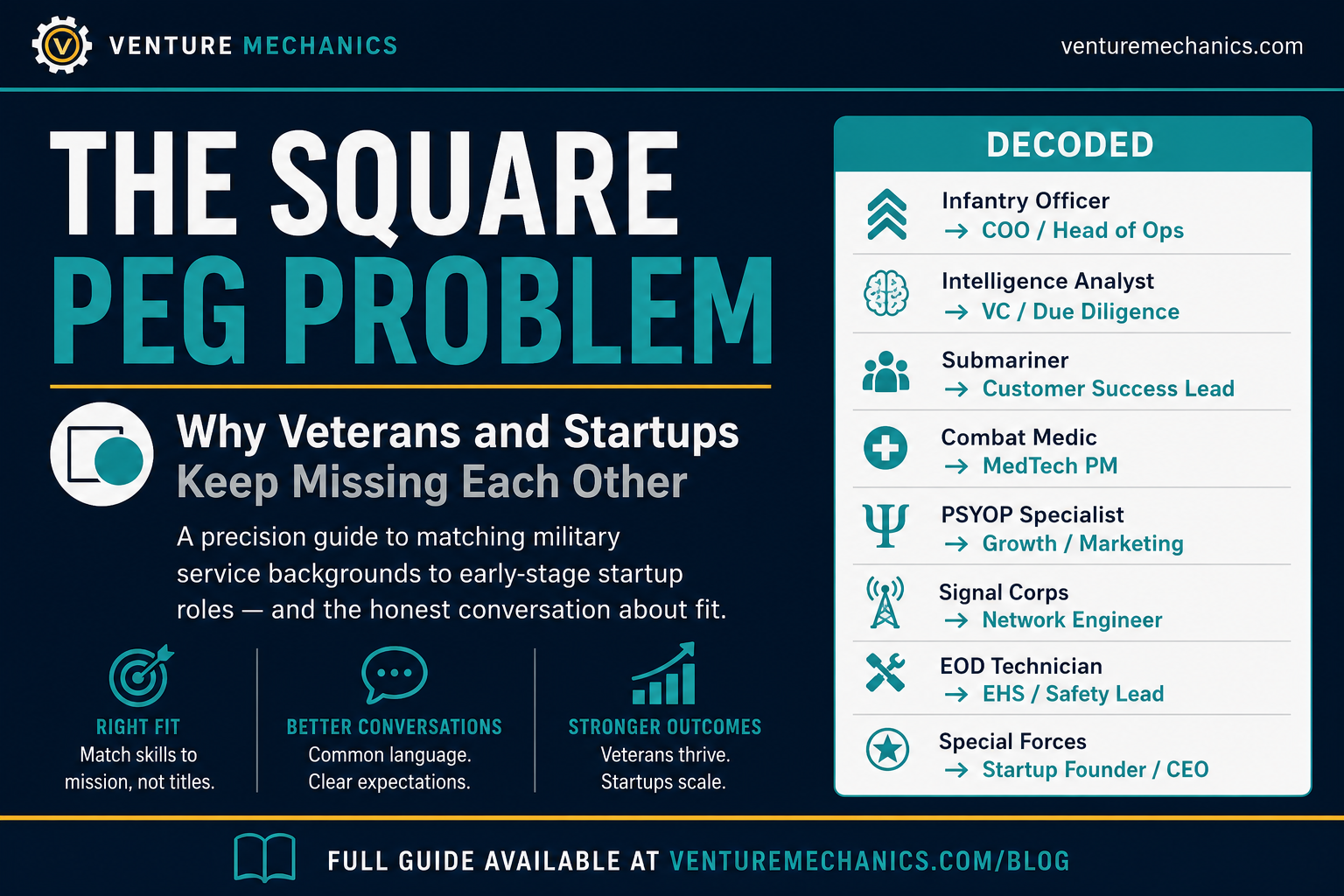
I've been in the startup ecosystem for four decades. I've seen founders make almost every hiring mistake imaginable. But one pattern keeps nagging at me, and it's not getting enough attention.
Every year, roughly 200,000 service members leave the U.S. military. They're disciplined, mission-driven, loyal to a fault, calm under pressure, and experienced leading real teams through real consequences. And most of them are landing in jobs that underutilize them by 40%.
Meanwhile, startup founders are killing themselves trying to hire operators who can actually execute.
This isn't a funding problem. It's a translation problem.
The Gap Nobody Fixes
The standard veteran job search process works like this: take your military title, run it through an O*NET crosswalk, and get matched to something generic like "Operations Manager." Then spend six months wondering why no one calls back because your resume says "Platoon Sergeant, 3rd Battalion, 75th Ranger Regiment" and the ATS system has no idea what to do with that.
The civilian side isn't any better. Startup founders hear "hire veterans" and think it's a nice thing to do. They don't think of it as a competitive talent strategy. They should.
Here's what a founder sees when they look at a veteran resume: military jargon, unfamiliar titles, no recognizable company names.
Here's what's actually on that resume: someone who led a 40-person team with life-or-death accountability, managed $5M in equipment, executed under ambiguous orders in degraded conditions, and trained their own replacement before leaving. That's a COO in waiting.
The translation layer is broken on both sides, and nobody is fixing it.
Why I Built This Resource
I spent time recently thinking about the specific case of submariners. These are people who've been psychologically screened and trained to maintain composure during months-long deployments in a metal tube under the ocean, managing interpersonal tension in a space with no exits. The research on submarine personnel backs this up: they're specifically selected for problem-directed coping and sustained stress tolerance that most people simply don't have.
You know what startup role that profile maps perfectly to? Customer success leadership. The role that most early-stage SaaS companies fill with the person who was available, and then lose sleep over every time a big account goes sideways.
That's one example. There are hundreds of them.
So I commissioned a full research project mapping specific military occupational specialties, across all branches, to specific civilian and startup roles. Not skills-to-job-description matching. Psychographic matching. Behavioral profile to operating environment. The kind of mapping that tells you not just what someone can do, but where they'll actually thrive.
Attached is a Military-to-Startup Career Mapping Guide, which is specifically for founders and for veterans eyeing early-stage companies. Because a startup is not a large company with a smaller headcount. It is a different organism, and the veterans who thrive in that organism are a specific subset that you have to know how to identify.
The Honest Part Most Guides Skip
Here's what the cheerleader version of "hire veterans" leaves out: it's a mixed bag.
Veterans who loved military structure, who found the chain of command clarifying and the SOPs reassuring, are often going to have a rocky time at a seed-stage startup
where the "process" for onboarding new customers is whatever the founder did last time and didn't write down. That's not a character flaw. It's an operating system mismatch.
The veterans who are built for startups are usually the ones who quietly resented certain parts of military life. The ones who chafed against institutional inertia. Who thought "there has to be a better way" and couldn't get the Army to listen. Who thrived most when they were cut off from higher command and had to figure it out themselves.
Those veterans are already startup operators. They just haven't found the right founder yet.
There's also a risk on the other side. Some veterans arrive at a startup and immediately start painting stripes in the parking lot, building org charts and governance frameworks before the company has twenty customers. Startups at the earliest stages don't need perfect governance. They need momentum. Structure applied too early to an organization that hasn't found its shape yet creates friction that kills companies.
The guides address all of this honestly, including interview questions founders should use to screen for fit, red flags to watch for, and the "Chaos Navigator vs. Structured Builder" framework for matching veteran profile to startup stage.
The Hardware Angle
I want to flag one specific opportunity that I think is massively underexploited, because it sits at the intersection of everything Venture Mechanics cares about.
Defense tech hardware companies, the Andurils and Shield AIs of the world, but also the emerging wave of startups building autonomous vehicles, drones, robots, and soldier-systems, are designing equipment for customers they've never been. They run focus groups, field tests, and user research cycles trying to approximate what an experienced operator already knows from lived experience.
A veteran who has operated a system under fire, in the dark, in degraded conditions, knows things about failure modes and ergonomics and use-case realities that no lab will ever surface. That veteran as a product manager, field test engineer, or UX researcher collapses product development cycles in ways that are genuinely worth millions.
This is not charity hiring. This is competitive advantage.
The full guide includes a table of eighteen defense tech companies actively building these teams, and a breakdown of which specific veteran backgrounds map to which product roles. It's the kind of resource I wish had existed when I was watching founders in this space burn through product development budgets trying to get their hardware right.
If you're a founder: read the startup guide before your next operations, sales, or product hire. There's a non-trivial chance your ideal candidate is leaving the military in the next six months and hasn't been properly translated yet.
If you're a transitioning veteran: read both guides. The civilian mapping shows you the full landscape. The startup mapping gives you an honest assessment of where you'll thrive and where you'll struggle, and what to look for in a founder before you sign.
If you know someone in either category, send this to them. The translation gap is a solvable problem. It just needs more people who know the language on both sides.

